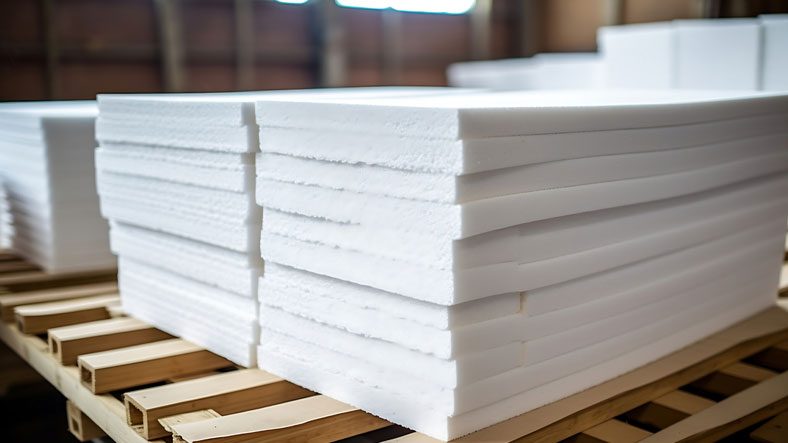
Extruded polystyrene (XPS) is a widely used material in the construction industry. The main reason for its popularity is its insulating capacity, a highly important feature. When used in buildings, it minimizes heat loss from the interior, thereby increasing energy efficiency. But there is much more you need to know.
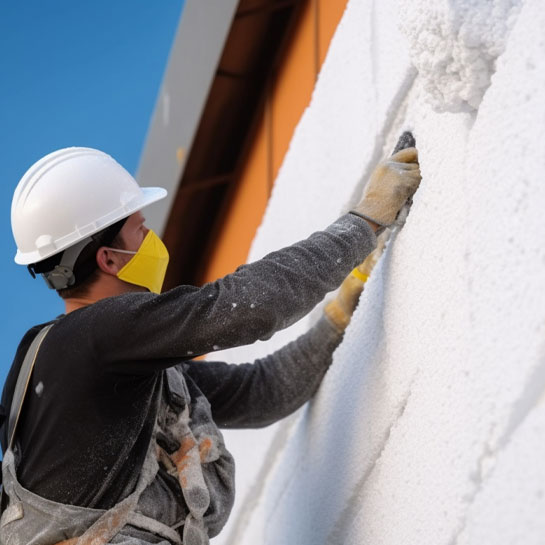
What is extruded polystyrene?
It is a plastic material obtained through extrusion, a process in which polystyrene is melted and fed into a mold to create sheets. These sheets have a closed-cell structure, which means they are made up of small gas bubbles trapped inside. This gives them highly valued characteristics, such as high moisture resistance and excellent thermal and acoustic insulation properties.
XPS is used in a wide variety of applications due to its properties. For example, it is used as insulation in building construction,
What is an inverted roof?
An inverted roof is a type of waterproofing system used in the construction of flat roofs or accessible terraces. When installing it,
Keep in mind that it provides good protection against sudden changes in temperature, ultraviolet rays, and other factors that contribute to degradation. It also increases a building’s energy efficiency by reducing heat transfer between the exterior and interior. Therefore, less energy is needed to maintain a room at a comfortable temperature.

What is your relationship with extruded polystyrene?
The relationship between extruded polystyrene and inverted roofs is easy to understand. When constructing the roof, the XPS is placed on top of the waterproofing membrane. This arrangement extends the useful life of the system by protecting the second layer. It keeps it away from the stresses it would be subjected to if it were exposed to the elements. It also minimizes the damage it could suffer from sudden changes in temperature.
Another interesting aspect of this combination is that the maintenance costs for the roof are lower. As the materials degrade less, you won’t have to invest as much in repairs in the long term. This means you achieve savings that you wouldn’t otherwise be able to achieve.
Differences between extruded and expanded polystyrene
The first difference can be found in the production method. To obtain XPS, polystyrene undergoes an extrusion process. However, expanded polystyrene or EPS is obtained by expanding beads of the material using steam. Given the way in which both are manufactured, there are some differences in the finish of each.
If you touch XPS, you will notice that the finish is smooth, while EPS is uneven and when you touch it you can feel small spheres of material. There are also differences in the characteristics they offer. Extruded foam has lower thermal conductivity due to its compact cellular structure. The result of this is that, with the same thickness, it provides better insulation.
Advantages of extruded polystyrene
XPS offers a number of advantages over other similar materials. The most notable are as follows:
- Excellent thermal insulation capacity. Its closed cell structure minimizes heat transfer, making it an effective insulator for maintaining stable indoor temperatures.
High moisture resistance. This is also due to its cellular structure, which makes the material highly resistant to water absorption. The direct consequence is that its insulating capacity remains even in humid conditions. XPS is therefore ideal for applications in areas where there is a risk of liquid infiltration.
Good mechanical resistance. Withstands compression and deformation without difficulty. These characteristics make it suitable for use where high structural strength is required, such as in ceilings, walls, and floors.
Lightweight. Despite its strength, XPS is lightweight and easy to handle, a quality that is extremely useful in the construction industry. This reduces the time needed to erect a building, resulting in lower labor costs.
Versatility in applications. The material can be used in all kinds of applications, including insulation for roofs, walls, and floors. But it also has applications in engineering and packaging. Its ease of cutting and molding allows it to be adapted to almost any design and construction need.
Fire resistance. Not only does it prevent heat transfer, but it also does not spread flames in the event of a fire.
Wide variety of colors. You can apply different shades depending on the aesthetic needs of the building.
Why use extruded polystyrene?
There are numerous reasons to use XPS in construction. The main one is that it is more economical than other options, which is essential if the available budget is not large. It is also a reusable material that does not contain components that are harmful to the environment. Therefore, you have a low-cost element that is also sustainable.
It even offers some sound insulation, in addition to thermal insulation. However, it does not stand out as much as other options, a disadvantage that is offset by its other features.
As you have seen, extracted polystyrene is a versatile material with excellent qualities. These qualities make it a popular solution, especially for insulated or inverted roofs. You will obtain good resistance, improve energy efficiency, and the cost of the work will be lower than with other options.