If you usually carry out DIY tasks at home, learning how to weld with an electrode will be great to expand your areas of action. It is a simple task that you can apply in multiple areas, from repairing metal parts to small plumbing or electrical work, so once you know the process you can solve different needs.
We talk about how to weld with electrode because it is the simplest and most practical option to work at home, unlike other more common options in other environments, such as the TIG welder or the wire welder. In any case, you should always protect yourself when carrying out a task of this type, so we also explain how to do it.
Before learning how to electrode weld
Although learning how to weld with electrode is not complicated, it is important that you take into account certain aspects before doing it. On the one hand, the materials and tools that are essential for this, which must also be in optimal conditions; on the other hand, and even more important, the necessary protections to carry out this work safely.
What do you need for electrode welding?
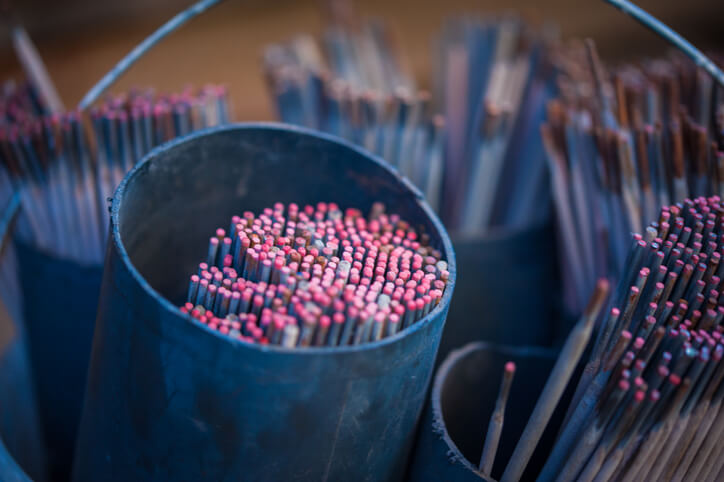
To weld with an electrode, it is obviously essential to have a connection to the mains, in addition to the welder, which does not necessarily have to be an inverter welder. It is also essential that you have the right electrodes, as the same ones are not always used, as well as the electrode holder and ground clamps. This would be essential, regardless of the pieces you are going to solder.
What are the necessary protections for electrode welding?
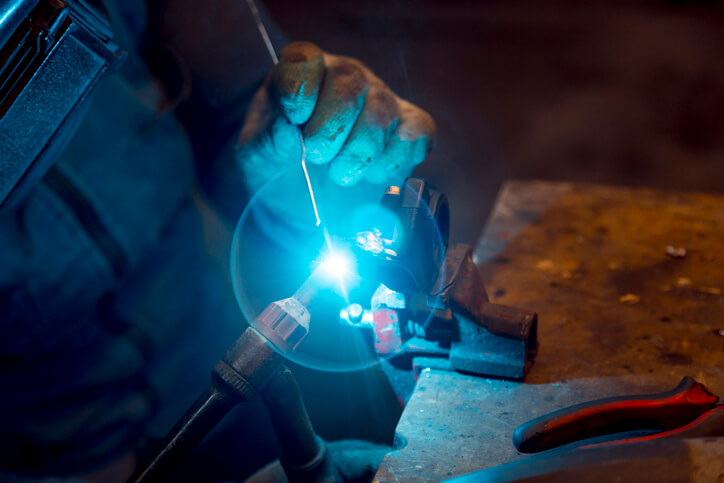
As for the protections you need, here is a list of all the essential PPE for electrode welding. Although it is true that not all of them are essential for each task, it is advisable to always use them to increase the safety of the process:
- Leather gloves, since it is the most suitable material against burns and metal impacts.
- Leather apron and sleeves for the same reason.
- Safety footwear to avoid blows as a consequence of metal detachment.
- Welding mask, the most important protection in this type of work.

How to weld with electrode step by step
If you know how to weld with an electrode, you will understand that the preparation of the process is more important than the task itself. That is, you need to prepare the parts to be welded, the tools and materials that we have mentioned and, finally, personal protective equipment. Finally you can start with the work, but let’s take a closer look at each of these steps.
Prepare metal parts to be welded
For a weld to be correct, regardless of the type of welder we are going to use, it is essential that the metal parts are prepared for the process. This means that they must be perfectly clean, which entails the removal of any dirt, grease, paint or coating and rust. Otherwise, the bonding of the parts will be much more fragile.
Organize the necessary elements
Now that you have prepared the parts, it is time to organize the rest of the necessary materials. Connect the terminals in place -the electrode holder to the negative pole and the clamp to the positive-, choose the most suitable electrode for the welding you are going to do and, finally, make a small calculation: multiply the diameter of the electrode by 35 and, rounding the result, you will be able to decide the amperage.
Protect yourself with the right PPE
As mentioned above, you don’t know how to weld with an electrode if you don’t understand the need to protect yourself when carrying out this work. In addition to equipping yourself with gloves, apron and leather sleeves, it is recommended that you wear appropriate clothing that offers thermal resistance, good safety footwear and, of course, your welding mask at all times.
In addition, it is advisable to change the filter of the mask depending on the type of welding, as not all of them are useful against any flash. It is important that none of the PPE is made from flammable or combustible materials, something that should also apply to your own clothing.
Lastly, you should never carry out this work in places where there is any risk of fire or explosion – due to the accumulation of gases, dust or any type of fuel. Again, these recommendations do not depend on the type of welder you use, as they are applicable in all cases.
Start welding the surface
Now it’s time to learn how to electrode weld, although all of the above is also part of the process. You must join both pieces and make linear movements across the joint from beginning to end and from one side to the other.
The force you apply is also important: the metal melts very quickly in case of excess and generates small balls if applied weakly. When you are done, you just have to do the same route hitting the joint with a pickaxe, this way you will remove the excess and you will also be able to check that the work has given good results.
How to weld with electrode using different techniques
Up to this point we have talked about how to weld with electrodes following the basic and most common technique in this type of work, but the truth is that there are different techniques. In all of them the processes around the preparation of the surface, the tools and the protection equipment is the same, but what changes in the welding system?
How to weld with electrode continuously
In reality, you already know how to weld continuously with an electrode, because that is the method we have already explained. If we delve a little deeper into this technique, you should bear in mind that the stroke from one side of the joint to the other should be curved and that the length of the weld will depend on the size of the metal pieces we are joining.

How to spot weld with electrode
But when it comes to electrode welding there is an even more basic technique than the previous one, although it is true that it is only applicable when joining small pieces -otherwise the weld would not be strong-. In this case, you must follow the same process with a small difference: leave small gaps between welds depending on the size of the parts and the length of the joint.
How to make an invisible electrode weld
Invisible welding is not common, except in jobs where the result will be exposed and clearly visible. The process is more complex, since, before welding, we must make a groove in the joint of the metal parts to be joined. With the radial saw, we will make an incision in the shape of a “V” in both parts along the entire length of the joint, so that we can weld in this space. In this way, the pieces will be joined almost imperceptibly.
Why learn how to electrode weld?
Although it’s not something you’ll use at home very often, if you like to take care of any repairs you may need to do yourself, knowing how to weld with an electrode will help you save on labor. In fact, in case you’ve done small jobs on your home’s electrical wiring or plumbing, you know that some problems can only be solved by welding.
Now that you have learned how to weld with electrode, you only have to get the necessary materials and, of course, the protective equipment to avoid accidents. Keep in mind that this is an investment that you will amortize after a few uses of the tool, since we are talking about a job that usually pays dearly as a result of the shortage of professionals in this sector.
What do you need to weld with an electrode at home?
To weld with an electrode, you need: an electrical connection, a welder (preferably an inverter), suitable electrodes, electrode holders, earth clamps and the parts to be joined. You must also have protective equipment such as a mask, gloves and fireproof clothing.
What is the most important protection when welding with electrodes?
The most important piece of protective equipment is the welding mask, as it prevents serious injuries to the eyes and face from sparks, radiation and flashes. It is complemented by leather gloves, an apron, sleeves and safety footwear.
How is the amperage regulated for electrode welding?
The amperage is calculated by multiplying the diameter of the electrode by 35. For example, a 2 mm electrode requires about 70 amps. Adjusting the intensity correctly is key to avoiding burning the metal or producing a weak weld.
What techniques are there for electrode welding?
The main techniques are:
-Continuous welding: curved line along the entire joint.
-Spot welding: ideal for small pieces, leaving spaces between spots.
-Invisible welding: performed in a V-shaped groove for a discreet finish.
What mistakes should be avoided when welding with electrodes?
Some common mistakes are welding without cleaning the parts, not using adequate protection, applying too much or too little force, not calculating the amperage correctly, and working in areas with a risk of fire or poor ventilation.