Choosing the right pool coping is of great importance both aesthetically and functionally. But what are the types of materials and the most interesting designs you have at your disposal? To these two questions we are going to answer in ParaTuReforma with the purpose of giving you a hand.
Edges of a swimming pool
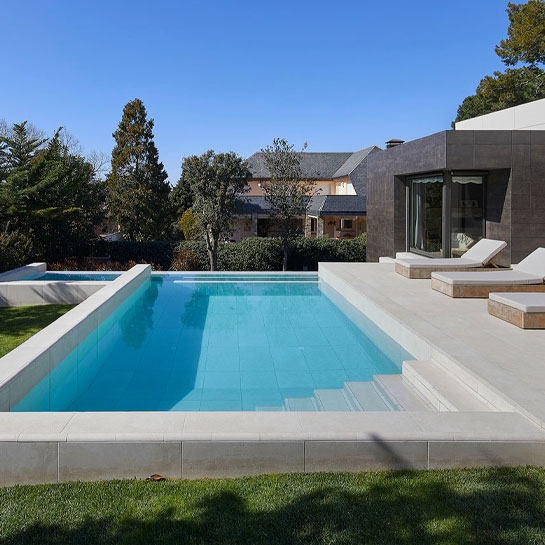
The edges of a swimming pool are called crown. It is a set of pieces whose function is to delimit the water container in which you bathe and that must meet a series of characteristics:
- Non-slip: This is the most important quality. The edge of the pool is an external component that is almost permanently in contact with the water. In addition, through it you enter the pool to swim, so it has to offer a good grip, whether you are wearing shoes or not, to avoid falls.
- Do not transmit heat: Many times you will be walking barefoot on the crowning edge, so it is essential that you do not notice that the surface is hot when you do so. Not even during the middle hours of the day.
- Resistance to ultraviolet radiation: The sun can end up deteriorating the appearance of many materials. Therefore, it is important that the one used in the crown of your pool has a treatment that supports its direct action for many hours every day.
- Moisture resistance: Moisture can also be detrimental to the material of manufacture. The use of a waterproof material or one with a special treatment against humidity is essential in this regard.
Types of materials
There are many materials that you can use in the edges of your pool. However, the ones we are going to mention below are the most popular, since they are the ones that best fit the characteristics we have mentioned before:
- Natural stone: It was the material preferred by users for a long time due to its aesthetic beauty. However, nowadays, it is not so popular, since its price is usually quite high. However, it looks great in pools located in rustic environments.
- Cement: This is a good alternative, since it offers a great sensation of continuity and conceals the joints very well. Even so, its price is high and it requires an important work for its installation.
- Porcelain stoneware: It complies perfectly with the above-mentioned characteristics. In addition, it has the ability to perfectly imitate the rest of the materials we have mentioned, including wood. Therefore, it is currently the most chosen option for those who build a swimming pool in their garden.
- Gresite: These small ceramic tiles that are used on the floor and walls of the pool as a liner can be used on the edges. Their main advantage is at the aesthetic level, because they give uniformity to the whole.

Pool edging designs
There are three types of pool coping designs according to their shape. They are as follows:
- Rounded edges: They are the safest of all, since they have no edges against which you can hit, for example, when you fall. They also have a very modern appearance.
- Flat edges: The traditional ones. They are not as nice or safe, but they are more economical. They are commonly installed in swimming pools.
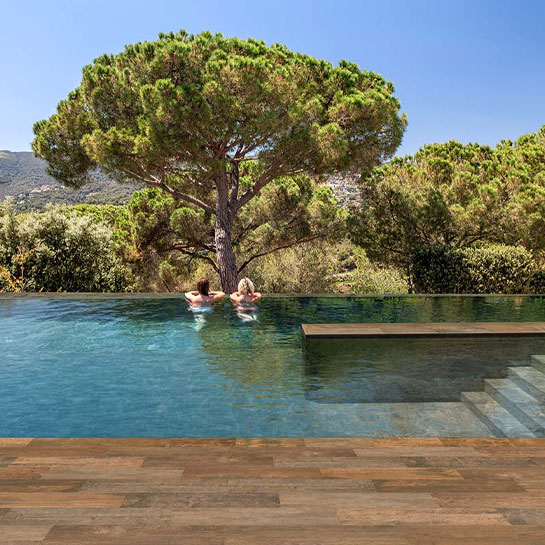
- Infinite borders: This type of crowns can only be installed in infinity edge pools, that is, in those in which they want to be reduced to a minimum to give a sense of continuity with respect to the landscape. They are generally used in pools located in front of the sea and are called overflowing borders.
Having clarified this issue, it is time to explain the possibilities that porcelain stoneware offers in terms of design.
Imitation wood
Natural wood is a material that presents many disadvantages when it is to be installed on the edges of a swimming pool. After all, it is not very resistant to humidity and the action of the sun’s ultraviolet rays, so it requires a great effort in maintenance.
Despite this, it offers very interesting aesthetic qualities, which is why many people want to bet on it when making the crown of their pool. Is this your case? Then you should know that, currently, porcelain stoneware offers the possibility of imitating its aesthetics to perfection.
For example, in ParaTuReforma we have imitation wood pool borders in four different colors. All of them are equipped with veins that give the tiles a very natural look. In addition, they are very easy to clean and bring a touch of warmth to the environment.
Imitation stone
Can you imagine what your pool would look like if its edges were made of granite or marble? Maybe yes, but surely your pocket can’t afford it. In this sense, porcelain stoneware also gives you the possibility to perfectly imitate this type of natural stone, as well as many others.
Also, this material does not have most of the disadvantages of natural stone. We speak, for example, of its ability to conduct heat or the need to polish its surface from time to time. It is also not porous, so it does not stain or absorb moisture.
Imitation cement
Finally, porcelain stoneware on the edges of a swimming pool is capable of imitating cement finishes in great detail. A good example is Iconic Dark, one of our most popular and modern crowns. Likewise, it can be installed on steps and copings without any problem.
As you have been able to see, porcelain stoneware provides you with a wide variety of options when it comes to installing the edges of a swimming pool. In fact, it is a material with excellent qualities, an exceptional value for money and a very outstanding ability to mimic the aesthetics of any other. Contact ParaTuReforma if you have any questions or if you have found the ideal tile for you and want us to give you a quote.
What material is best for pool edges?
Porcelain stoneware is currently the most recommended material thanks to its strength, durability, aesthetics, and ability to imitate wood, stone, or cement. In addition, it is non-slip, resistant to sunlight and moisture, and easy to maintain.
What types of designs are available for pool coping?
The main designs are:
-Rounded edges, more modern and safer.
-Flat edges, traditional and economical.
-Infinity edges, designed for overflow pools and panoramic views.
Is natural stone suitable for pool edges?
Yes, but it has drawbacks: it is more expensive, it can heat up in the sun, and it requires maintenance. That is why many users opt for stone-effect porcelain tiles, which offer the same aesthetic appeal without the disadvantages.
Can I install wood around the edges of the pool?
Natural wood is not the ideal choice due to its sensitivity to moisture and sunlight. The most practical alternative is wood-effect porcelain stoneware, which retains the warm, elegant look without any maintenance issues.
What are the advantages of porcelain tiles for pool edges?
Features:
✔ Non-slip
✔ Heat and UV resistant
✔ Waterproof
✔ Easy to clean
✔ Wide variety of designs
✔ Excellent value for money
It can also be installed on coping, steps, and flashings without any problems.