
Are you trying to place a picture, a mirror, a flower pot or a small shelf and you don’t want to drill holes in the wall under any circumstances? It is a very common problem, but thanks to the progress in DIY products it can be solved in a simple way. Hanging things without drilling is possible, you just need to know how to do it and which products to use.
There are countless options to carry out this task, but it is convenient to know all the possibilities to understand which is the most appropriate in each case. Below, we talk about all of them and tell you how to hang heavy things without drilling, as well as offer some recommendations and solve all your doubts about this work.
Which system to use based on weight
| Weight of the object | Recommended System | Hang in there | When Not to Use It |
| Up to 2–3 kg (picture frames, plants, clock) | Hooks or adhesive strips | Uploading the manufacturer’s data sheet | Wall with un dried paint, moisture, and textured finish |
| 3–8 kg (large frame, lightweight shelf) | Several high-load adhesive strips distributed throughout | 6–8 kg, securely installed | Mirrors above beds, in bathrooms, and in kitchens |
| More than 8 kg (large picture, bookshelf with books) | Drill using the appropriate drill bit | Screw for drywall or plaster: 22–45 kg | – |
| Tall cabinet | Wall Mount | Depending on the anchor | Never use adhesive alone |
What options do you have for hanging heavy things without drilling?
When it comes to hanging heavy things without drilling, the first thing to do is to assess the possibilities and resources available. Keep in mind that there are alternatives that are better than others in terms of factors such as weight or aesthetics, so you must be very clear about the use you are going to give and the results you expect to obtain with the following options:
Tension systems
Hanging heavy things without drilling is not merely a decorative task, but we can also resort to it for functional purposes, as for example in the installation of curtains, towel racks and clothes hangers or some types of shelves. In this case, tensioning systems, which consists of fitting a bar between two flat surfaces -two walls or the ceiling and the floor- can be the solution.
Mounting tapes
If we want to avoid perforating walls, one of the simplest and most widely used methods are mounting tapes. To understand this, they are also called double-sided adhesive tapes, manufactured specifically for this purpose. Although well used they can support considerable weights, it is not the most durable alternative in this regard.
Suction cup hangers
While it is true that suction cups are not the most aesthetic element that we can use in decoration, when it comes to hang heavy things without drilling on completely smooth surfaces can be a great option. Just make sure they are of good quality and, of course, that they are completely hidden behind whatever you intend to install on them.

Floating shelves
Floating shelves are one of the best options visually to achieve the results we are looking for. While it is true that many of them require drilling holes in the wall, we can also find them with special adhesives and thus avoid drilling twice. In any case, if you already have one of these pieces of furniture, consider installing your heavy decorations on it.
Adhesive hooks
Finally, adhesive hooks are intended exclusively for hanging heavy things without drilling, so the manufacturer generally indicates how much weight each type of product could support. However, our recommendation is not to adjust the weight too much, as this option will never be able to match the screws.
Heavy pictures and mirrors without drilling holes
For a picture or mirror weighing more than 5 kg, don’t rely on a single point: distribute the weight across two or more strips and add up their maximum load capacities, leaving some margin (the object should weigh, at most, half of what the entire setup can hold). Stick the strips near the corners, vertically, and wait for the curing time specified by the manufacturer before hanging the item.
The mirror should also be hung on a smooth, dry wall, away from bathrooms and kitchens, and never above a bed or a sofa: if it falls, it shouldn’t land on anyone.
Shelf boards and shelving units that don’t require drilling
Adhesive brackets are suitable for lightweight items: spices, small plants, picture frames. For books or heavy objects, there are three options: floor-to-ceiling tension shelving, freestanding shelving, or a low cabinet to serve as a base.
A tall piece of furniture that isn’t secured to the wall can tip over. If there are children at home, this is the only situation in which it’s worth drilling a single hole.
Headboards without holes
A headboard attaches more securely to the box spring or bed frame than to the wall. If it’s a lightweight panel (upholstered, foam, or thin wood), use heavy-duty mounting strips or double-sided foam tape around the entire perimeter and in the center. Test it first by letting it cure for 24 hours, and avoid highly porous matte paint or textured paint.
How to hang heavy things without drilling
Now that we’ve gone through all the options available for hanging heavy things without drilling, it’s time to explain the step-by-step to do it successfully. Keep in mind that no matter how much weight the materials you have chosen can support, the process involves some preparation to ensure a proper result.
Hooks and Nails Without a Drill
If you’re looking for a “drill-free” wall hook, there are two options: adhesive hooks (for light loads) and steel wall nails, which can be hammered into drywall or plaster without a drill bit. They can hold little more than a medium-sized picture frame and aren’t suitable for brick or concrete. For weights over 5 kg, use an expansion anchor or drill a hole.
Select the most suitable support in each case
As you can see, we have mentioned up to 5 different possibilities to achieve the objective of avoiding holes. However, it is up to you to choose the most convenient alternative in each case. To do this, study the type of object you are going to hang, its weight, its shape and the characteristics of the surface where it will be installed. Remember to value durability and aesthetics above all else.
Prepares the surface to hang heavy items without drilling
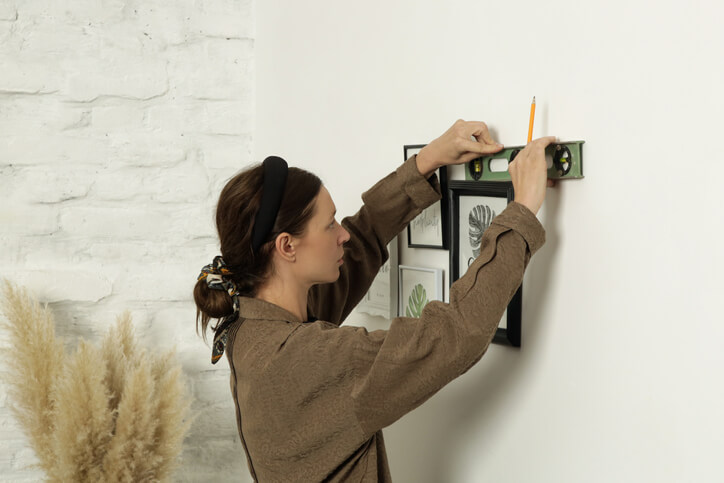
Remove possible residues of any kind from the surface where you are going to install the support, especially if they are options that work with adhesives. There must be no dust or grease and it must be completely clean and dry, for which isopropyl alcohol works very well. Finally, check the manufacturer’s instructions to make sure that the product works on the chosen surface.
Install the bracket and adjust it to fit perfectly.
Finally, and without losing sight of the manufacturer’s instructions, it is time to install the new substrate. It is essential that you follow to the letter the recommendations regarding the pressure to be applied, the drying time in the case of adhesives, etc. Finally, adjust it perfectly before hanging anything on it.
Everything you need to know before hanging heavy things without drilling
In the world of do-it-yourself and decoration, it is common to ask questions about the activities that are being carried out. When it comes to hanging heavy things without drilling, there are certain doubts that are recurrently repeated and that can be cleared with some experience in this area, such as the following:
How much weight does a screw support?
To understand why it is sometimes unavoidable to drill -or not to hang something that is too heavy to resort to other alternatives-, it is important to know the weight that a screw can support. Although, obviously, this is something that depends on the type of screw, its thickness and length, it is estimated that it can support an average of between 22 and 45 Kgs on plaster surfaces and a greater load on brick or concrete walls.
How much weight can an adhesive backing support?
On the contrary, if we talk about adhesive supports, the supported load is considerably reduced. In the case of top quality products, well installed, they can support weights of between 6 and 8 kg and can be combined to increase the weight to be supported, but never reach the support offered by a screw.
How can you hang heavy things without ruining the paint?
One of the most recurring concerns when it comes to hanging things without drilling is the possibility of damaging the paint on the walls. However, there are adhesives designed for the purpose of not damaging painted surfaces, so this would be an option to consider.
What Works on Each Surface
| Area | What Works | What to Avoid |
| Painted, smooth wall | Adhesive strips and hooks | Freshly applied paint: wait a few weeks |
| Tile | Suction Cups and Adhesives for Tiles | Grout and embossed tiles |
| Drywall | Expansion anchors | Nails for medium loads |
| Textured plaster or rough plaster | Virtually no adhesive solutions | Stickers |
| Brick or concrete | Drill with a drill bit | High-Load Adhesives |
Recommendations when hanging anything heavy without drilling
Apart from the usual questions from users about hanging heavy things without drilling, there are certain recommendations that can facilitate a good result if followed correctly. In addition, of course, it is important to insist on the importance of respecting the manufacturer’s instructions.
Balanced weight distribution
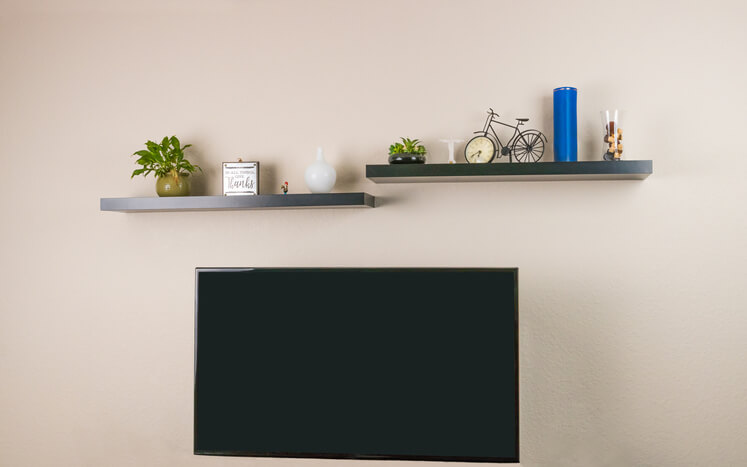
In the same way that we do when we hang any element with screws, it is essential to balance the weight in the case of adhesive supports or any other type. Keep in mind that you may need to use more than one support because of the weight, the size of the object you are going to install or for any other reason. Try to make sure that all the hooks you use have the same weight.
Performs proper maintenance on the brackets
To prevent decorative elements from falling and consequently breaking down, it is highly recommended to carry out maintenance work on the supports. This is a simple procedure in which you only have to check if they are still well adhered to the surface or if they need to be replaced more or less urgently to preserve the stability of the installation.

Why learn how to hang heavy things without drilling?
As you can see, there are many options to choose from when it comes to hanging heavy things without drilling. Normally we are clear that for light decorations there is no problem with brackets, but doubts lurk when we are going to install any element of a certain size on our walls. The ideal is to avoid drilling, and experience tells us that it is possible.
Following these recommendations and always taking into account the particularities of each case, such as the exact weight of the item to be placed, the weight that each support can withstand or the type of wall, you can hang heavy things without drilling in most circumstances. Of course, do not forget to use quality brackets to avoid damaging the paint if at some point you decide to remove them.
How to Remove It Without Damaging the Paint
Pull the adhesive tab downward, parallel to the wall, and slowly, stretching it about 10–15 cm until it gives way. If it resists, heat it for a few seconds with a hair dryer. Always follow the manufacturer’s instructions.
Is it really safe to hang heavy objects without drilling holes?
Yes, provided you use the appropriate system for each surface and comply with the maximum weight recommended by the manufacturer. High-quality adhesive mounts, tension bars, or suction cups can support significant loads, although they will never match the strength of a screw.
What is the most reliable method for hanging heavy objects without drilling holes?
Tension systems and high-strength adhesive hooks are usually the most reliable options. They are ideal for hanging mirrors, curtains, towel racks, or light shelves, provided that the surface is suitable and well prepared.
How much weight can the adhesive hooks hold without drilling?
The best adhesives can support between 6 and 8 kg per fixing point. It is possible to combine several supports to increase resistance, but they will never reach the load capacity of a screw in the wall.
Can I hang things without drilling holes in painted walls?
Yes. There are adhesive mounts designed not to damage paintwork, provided they are installed and removed correctly. Even so, it is recommended to check that the surface is clean and completely smooth to prevent them from coming loose.
Which surfaces are not suitable for hanging heavy objects with adhesives?
Porous, rough, or damp surfaces, such as textured walls, untreated cement, or textured tiles, are not compatible with adhesives. In these cases, tension systems or mechanical solutions without drilling may work better.
Is it possible to hang a large mirror without drilling?
Yes, if it weighs less than the strip system can hold (with a margin of double that weight) and the wall is smooth, dry, and far from bathrooms and kitchens. If it weighs more than about 8 kg, drill holes.
How do I install shelves without drilling?
Use adhesive mounts if they’re lightweight, or a tension-mounted shelf or a freestanding shelf if you need more storage space. A tall piece of furniture must always be anchored.
How do I attach a headboard to the wall without drilling holes?
With heavy-duty mounting strips or double-sided foam tape around the entire perimeter. If it’s heavy, this will secure the headboard more firmly to the box spring.
How long does it take for a band-aid to heal?
Follow the manufacturer’s recommended time before hanging the weight. If you don’t follow this, it won’t last as long.
How do I remove an adhesive strip without damaging the paint?
Gently pull the tab downward, parallel to the wall, and slowly. If it’s stuck, warm it up for a few seconds with a hair dryer.