
Dealing with annoying noise coming from the neighboring home is one of the main causes of stress at home. Hearing conversations, the television, or the daily activities of the next-door neighbor drastically reduces any family’s comfort and ability to rest. Faced with this situation, the first reaction is often to consider a comprehensive renovation involving drywall and mineral wool insulation. However, it is not always possible or desirable to deal with the dust, debris, and loss of space involved in erecting a traditional structure.
At Paratureforma, we like to address soundproofing needs with complete transparency and realism. Before taking any action, it is essential to understand the nature of sound in order to properly manage expectations: impact noise (footsteps, blows to the floor slab, falling objects, or vibrations) is transmitted through the building’s structure itself and is extremely difficult to eliminate completely without undertaking significant construction work. In contrast, airborne noise (voices, music at moderate volumes, or background noise) travels through the air and through weaker walls, so it is possible to reduce its intensity using aesthetic, functional, and non-invasive solutions.
Next, we’ll examine how sound travels through walls and discuss the most effective materials and non-structural solutions for improving sound insulation in your home.

1. Understanding the Problem: Airborne Noise vs. Impact Noise
To select the appropriate solution, it is necessary to distinguish between the two main ways in which noise penetrates a shared wall.
- Airborne Noise: This is noise that originates in the air and causes the wall to vibrate. Clear examples include conversations, the sound of a television, or a baby crying. Since it is transmitted primarily through reflection and through small cracks or acoustic bridges in the wall, it can be significantly reduced by increasing the wall’s mass, absorption, and airtightness.
- Impact or Structural Noise: This is generated by a direct physical impact against the building’s structure, such as footsteps on the floor above, dragging furniture, or slamming doors. This mechanical energy travels through the beams, columns, and floor slabs in a solid manner, causing adjacent walls to act as loudspeakers. To decouple this vibration, elastic suspension systems and heavy damping layers are required—measures that almost always involve construction work.
2. Diagnosis of Acoustic Bridges and Weak Points
Before installing any insulation on the wall, it is essential to locate and seal the gaps through which air—and consequently sound—seeps unimpeded.
2.1. Electrical Enclosures
Outlet and switch boxes are usually recessed into the wall in positions that align with those in the neighboring home, leaving a minimum brick-thickness gap between the two buildings.
- Solution: Disconnect the power supply, remove the trim pieces, and seal any gaps inside the enclosure with high-density acoustic sealant or insulation shells specifically designed for junction boxes.
2.2. Perimeter joints and cracks
Sound travels through even the smallest cracks in the drywall or the joints where the wall meets the ceiling and floor.
- Solution: Thoroughly inspect the wall surface. Seal any existing cracks using elastic polyurethane sealants or high-density neutral silicones.
3. Direct Solutions Without Construction to Reduce Airborne Noise
There are easy-to-install soundproofing solutions that combine sound-absorbing properties with decorative finishes, allowing you to insulate walls against noise from neighbors without construction work—in a clean and affordable way.
3.1. Textile and PET Felt Acoustic Panels
Decorative panels made of pressed polyester fiber (PET) or finished with felt and synthetic wood slats are one of the most effective ways to reduce reverberation and airborne sound transmission in rooms.
- Mechanism: The porous structure of the tissue traps high- and mid-frequency sound waves (such as voices), converting acoustic energy into heat.
- Installation: They are attached directly to the wall using instant-grip mounting adhesives or heavy-duty mounting strips, without the need to drill holes or alter the drywall.
3.2. High-Density Cork Panels or Thermal-Acoustic Agglomerate
Cork is a natural polymer with a cellular microstructure filled with trapped air, which gives it remarkable thermal insulation and sound-dampening properties.
- Mechanism: It provides an open-cell cushioning layer that absorbs the incident wave.
- Installation: It is sold in tiles or rolls with reinforced density that are glued to the plastered wall surface. They can then be painted or covered with heavyweight wallpaper to blend in with the decor.
3.3. Self-Adhesive Viscoelastic Acoustic Membranes
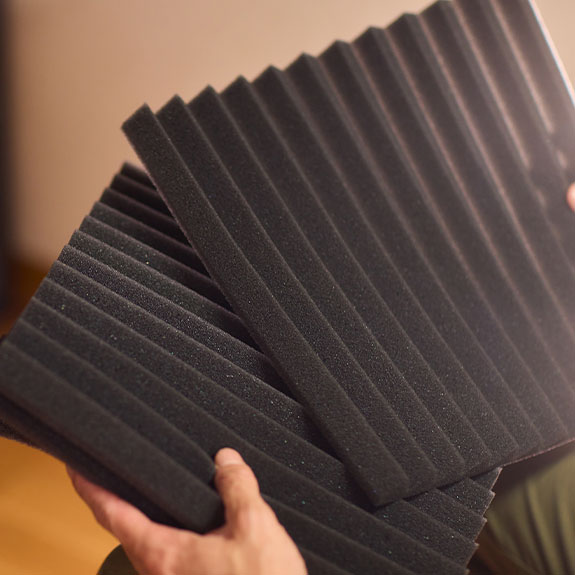
These are high-density, thin synthetic sheets (between 2 mm and 4 mm thick) specifically designed to add mass to lightweight elements without sacrificing living space.
- Mechanism: The high mass per square meter of these membranes dampens the vibrational behavior of the brick or hollow partitions.
- Installation: They feature a self-adhesive backing that allows them to be attached directly to the existing wall. For a flawless aesthetic finish, they are usually covered afterward with decorative panels or fabric.
| No-Construction Solution | Type of Noise It Attenuates | Installation Difficulty |
| -PET Felt Panels / Slatted -Agglomerated Cork Tiles -Thin Viscoelastic Membrane | -Airborne Noise (voices, high-frequency sounds) -Mid-range Airborne Noise / Interior Echo -Structure-borne vibration in thin partitions | Very low (Mounting adhesive) Low (Stick to wall) Medium (Requires covering) |
4. Complementary Furniture and Decor Strategies
In addition to using specific absorbent materials, rearranging the room’s interior elements significantly helps to create physical barriers between the room and the problematic wall.
- Bookcases and wall-to-wall shelving: A large-scale bookshelf mounted or placed along the shared wall, filled with books of various sizes, creates a heterogeneous, massive layer that scatters sound waves.
- Upholstered headboards: If the problem is in the bedroom, installing a large, padded headboard made of high-density foam and fabric helps dampen the direct transmission of voices coming from the other side.
- Heavy drapes and textiles: Using plush rugs and heavy-weight acoustic curtains in the room reduces internal reverberation, making outside noises much less noticeable and annoying.
5. Procedure for Installing Direct Insulation Panels
To ensure that the adhesive treatment lasts over time without peeling off, follow this step-by-step procedure:
Step 1: Preparing the Surface
Thoroughly clean the wall surface by removing accumulated dust, loose paint, or grease with a damp cloth. Wait until the wall is completely dry.
Step 2: Laying Out the Installation
Use a spirit level to draw a horizontal guide line to ensure that the first row of panels or tiles is perfectly aligned.
Step 3: Applying the Adhesive
Apply continuous beads of mounting adhesive specifically designed for acoustic panels to the back of the pieces, or remove the protective film if using self-adhesive sheets.
Step 4: Fastening and Sealing
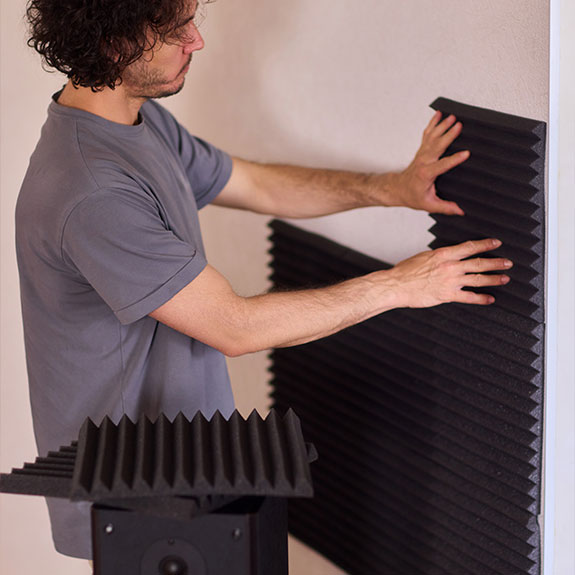
Align the panel against the wall and press firmly for a few seconds. Make sure the joints between the panels fit tightly together to prevent gaps through which sound could leak.
Conclusion
Reducing noise disturbances from outside doesn’t always require a lengthy construction process. Identifying air leaks in mechanical enclosures, sealing perimeter joints, and applying high-density solutions such as viscoelastic membranes, PET panels, or cork coverings can drastically reduce the impact of airborne noise, restoring peace and quiet to your space with a clean and aesthetically pleasing solution.
In paratureforma’s online catalog, you’ll find a carefully curated selection of high-density sealants, elastic putties, technical mounting adhesives, and insulation components to quickly and efficiently improve the thermal and acoustic insulation of your home.
Is it possible to completely eliminate noise from neighbors without doing any construction work?
We have to be realistic: without construction work, it is very difficult to completely eliminate impact noise (thuds, footsteps, or furniture being dragged) because it is transmitted through the building’s structure. However, it is possible to drastically reduce airborne noise (voices, television, music) by using sound-absorbing materials and sealing cracks.
Why can I hear my neighbors through the wall outlets?
Outlet boxes are usually recessed into shared walls, leaving very little brick thickness between the two units. These openings act as acoustic bridges. The solution is to remove the trim and seal the interior with acoustic caulk or insulating shells.
What are PET felt acoustic panels, and how do they help?
These are decorative panels made of porous pressed fiber that absorb sound waves (such as voices) and reduce echoes. They are very easy to install because they are attached directly to the wall with mounting adhesive, without the need for drilling.
How does a viscoelastic acoustic membrane work?
It is a very thin (2 to 4 mm) synthetic sheet that is nevertheless high-density and heavy. When affixed to the wall, its substantial mass dampens vibrations in the brick or cinder block, blocking the passage of sound. It is usually covered afterward with panels or wallpaper.
Yes, and very effectively. Installing a full-wall bookshelf filled with books creates a thick layer that scatters sound. In the bedroom, using a large, padded headboard also dampens direct noise.