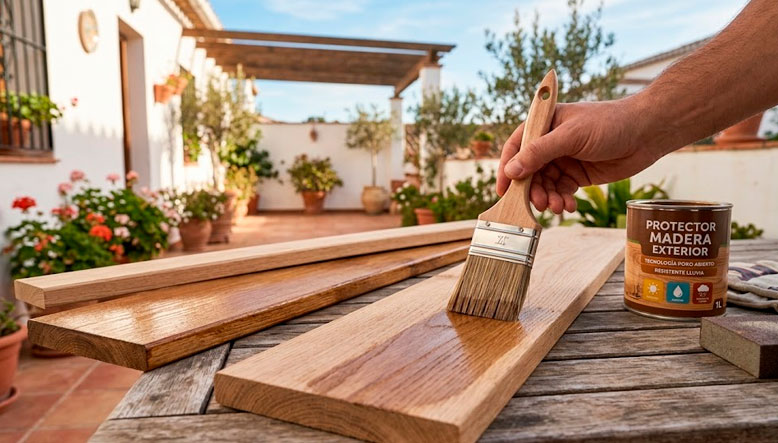
Wood is one of the most elegant, warm, and versatile materials we can use in outdoor spaces such as patios, gardens, pergolas, and facades. However, due to its organic and porous nature, it requires proper protection when exposed to inclement weather.
The continuous exposure to rainwater, dew, and ambient moisture can trigger rotting, dimensional changes, swelling, the growth of wood-destroying fungi, and irreversible cosmetic deterioration.
At Paratureforma, we know that keeping wooden structures and infrastructure in perfect condition doesn’t depend on miracles, but rather on applying the appropriate preventive and preservative treatments from the very beginning. Knowing how to provide long-lasting protection for exterior wood against rain involves understanding how liquids interact with plant fibers and determining which type of chemical or physical protective treatment is best suited for each type of element or structure.
Next, we will analyze the mechanisms of degradation in exposed wood and detail the products, methodologies, and technical steps necessary to preserve its properties over the years.

1. Threat Mapping: Why Does Wood Suffer When Exposed to the Elements?
Wood is a hygroscopic material, which means it absorbs and releases moisture depending on environmental conditions. When rainwater comes into contact with unprotected wood, various factors that contribute to deterioration are triggered:
- Wood is a hygroscopic material, which means it absorbs and releases moisture depending on environmental conditions. When rainwater comes into contact with unprotected wood, various factors that contribute to deterioration are triggered:
- Fungal and mold growth: Maintaining an indoor humidity level above 20% creates the ideal environment for the growth of rot fungi and chromogenic fungi (which stain wood with bluish or grayish hues).
- Leaching and loss of lignin: Solar radiation weakens the lignin (the natural binder of the fibers), allowing subsequent rain to wash it away. The result is that grayish hue and weathered appearance so characteristic of unprotected wood.
2. Varnish vs. Wood Stain: The Crucial Preservation Decision
When it comes to protecting a wooden item located outdoors, one of the most common mistakes is failing to choose the right product for the type of exposure. The distinction between varnish and wood stain is critical to successful maintenance.
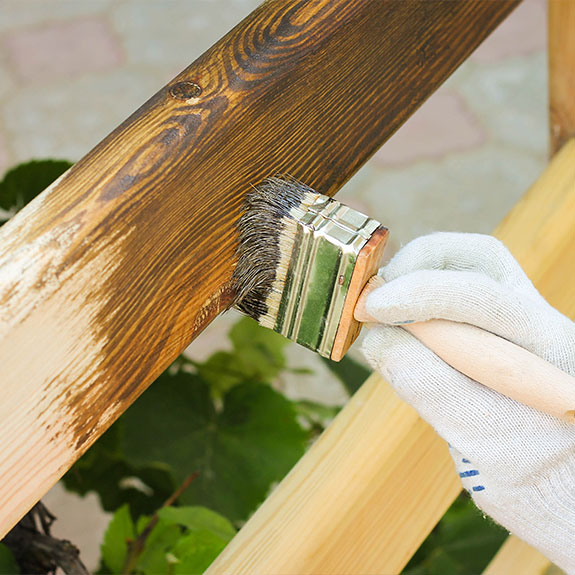
2.1. Traditional Varnish: Surface Film Protection
Varnish is a product that forms a protective layer—a continuous, rigid, and waterproof film—on the surface of the wood. While it initially provides a very attractive glossy or satin finish, it has serious drawbacks when used outdoors:
- Crapping effect: Because the varnish film does not accommodate the wood’s natural expansion and contraction, it eventually cracks.
- Water Trapping: Once the hard surface is broken, moisture from the environment or rain seeps in through the cracks and becomes trapped beneath it. The wood cannot release this water vapor, which accelerates internal rot and causes the varnish to flake off.
- Complex maintenance: To reapply varnish to a cracked surface, it is necessary to strip or sand it down thoroughly until the bare wood is exposed.
2.2. Lasur: Open-Pore Protection That Lets Wood Breathe
Wood stain is a penetrating protective coating made of extremely flexible resins that penetrate deep into the wood grain rather than forming a rigid film on the surface. It is the ideal solution for protecting exterior wood from rain for the following reasons:
- Open-pore structure and breathability: This allows the wood to release internal water vapor to the outside, preventing moisture from becoming trapped within the structure.
- High flexibility: It accommodates the dimensional changes in the wood without cracking or peeling.
- Enhanced UV protection: It typically contains micronized pigments and sunscreens that block ultraviolet radiation.
- Easy maintenance: When it’s time to renew the protection (usually every 2 to 5 years, depending on exposure), no sanding or stripping is required. Simply clean the surface and apply a new coat of wood stain directly.
| Traditional Varnish | Open-Pore Wood Stain |
| Creates a rigid surface film | Penetrates the fiber without a rigid coating |
| It cracks due to temperature changes | Adapts to natural expansion |
| Traps moisture beneath the layer | Let the wood breathe |
| Maintenance: Stripping and sanding | Maintenance: Stripping and sanding |
3. Surface Preparation: The Foundation for Perfect Adhesion
Applying any treatment to improperly prepared wood will drastically shorten the life of the protective coating. Before beginning the impregnation process, it is essential to follow a series of rigorous technical steps.
Step 1: Checking the Substrate’s Moisture Content
Make sure the wood is completely dry before applying any product. The internal moisture content should ideally be below 18–20%. Applying wood stain to damp wood will prevent the product from penetrating the pores properly.
Step 2: Cleaning and Degreasing
If the wood is new—especially if it is a resinous or tropical species (such as teak or ipé)—clean the surface with a suitable solvent to remove any excess natural oils that might interfere with absorption.
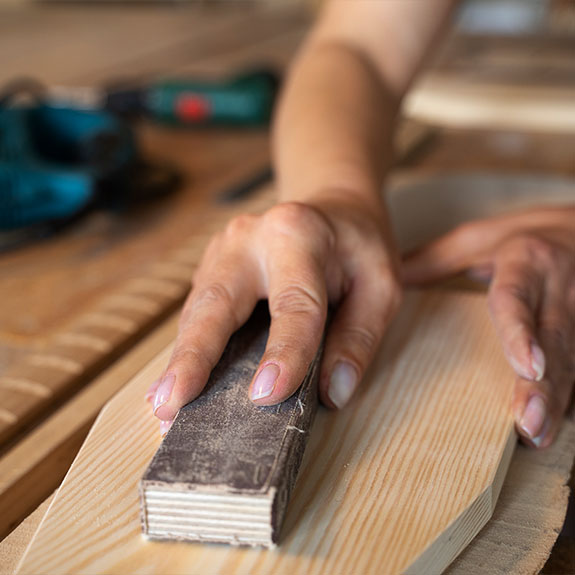
Step 3: Lightly sand along the grain
Lightly sand the surface using medium-grit sandpaper (P120 to P180). The purpose of sanding is not to wear down the wood, but to open the wood grain and remove any rough spots or irregularities to ensure even absorption of the wood stain. After sanding, thoroughly remove all dust with a dry cloth or compressed air.
4. Preventive Treatment: Fungicide and Insecticide Protection
Before applying a decorative or protective finish, the wood requires internal biological protection. Applying a primer or treatment base coat is essential if we want to ensure structural integrity against wood-destroying organisms.
- Applying the primer: Apply a generous coat of water- or solvent-based fungicidal and insecticidal primer. This clear liquid penetrates deeply, preventing the possible appearance of wood borers, termites, and rot-causing fungi.
- Impact on End Grains and Cross-Sections: Pay special attention to the end grains (the cross-sections of the wood), since it is through the end grains that the wood fibers absorb water most quickly (up to 20 times faster than through the side surfaces). Make sure to thoroughly saturate these areas with the base primer.
5. Step-by-Step Guide to Applying Weather-Resistant Wood Stain
Once the primer coat is dry (according to the manufacturer’s instructions), apply the open-pore protective wood stain.
Step 1: Choosing a shade
Always use wood stains that contain some pigment (teak, walnut, oak, etc.). Completely colorless wood stains do not offer the same resistance to UV rays under conditions of prolonged, intense sun exposure.
Step 2: First coat of wood stain
Mix the product thoroughly without stirring excessively to prevent the formation of bubbles. Using a high-quality synthetic or mixed-bristle paintbrush, apply the first coat by spreading the product along the grain of the wood. Avoid excessive buildup in corners or at joints.
Step 3: Drying and Interleaving
Allow the paint to dry completely (usually between 4 and 12 hours, depending on the formulation—whether water-based or solvent-based). Once dry, sand the surface very lightly with fine-grit sandpaper (P240) to remove any small bumps that may have formed. Wipe away the resulting dust.
Step 4: Second and Third Coats
Apply a second coat of wood stain using the same procedure. For wood exposed to extreme conditions such as constant rain, snow, or marine humidity, it is highly recommended to apply a third thin coat to maximize the water-repellent effect and seal the wood fibers.
6. Preventive Maintenance and Frequency of Service
Protecting wood is not a one-time task, but rather a cycle of preventive maintenance. Conducting regular inspections helps avoid the need for major restoration work in the future.
- The Water Test (Bead Effect): To check the effectiveness of the treatment, pour a few drops of water onto the treated wood. If the water forms spherical droplets that roll off the surface without soaking it, the protection remains intact. If the water spreads and quickly darkens the wood grain, it’s time to reapply the wood stain.
- Frequency of reapplication: In areas with high solar radiation and heavy rainfall, it is recommended to apply a fresh coat of wood stain every 2 or 3 years. Simply wash away any accumulated dust with water and mild soap, let it dry, and apply a thin coat directly to the surface.
Conclusion
Knowing how to protect exterior wood from rain requires an understanding of the material’s biological and physical needs. Relying on open-pore protectants such as wood stains, rather than solutions that form a rigid film like traditional varnishes, makes the difference between wood that bulges and cracks and a structure that remains healthy, flexible, and durable for decades.
In the specialized Paratureforma catalog, you’ll find a wide range of wood treatments, fungicidal primers, highly durable wood stains, sanding tools, and professional brushes designed to protect your pergolas, teak decks, fences, and siding with the highest quality assurance.
Why do rain and moisture damage outdoor wood?
Wood is hygroscopic and absorbs water, causing it to swell; as it dries, it shrinks. This constant cycle creates stresses that cause cracks and also promotes the growth of fungi and mold if the internal moisture content exceeds 20%.
What is the difference between using traditional varnish and wood stain outdoors?
Varnish creates a rigid surface film that eventually cracks due to temperature changes, trapping moisture inside. Wood stain penetrates the open pores, deeply protects the wood fibers, and allows the wood to breathe without cracking.
How should I prepare the surface before applying the protective coating?
You must make sure the wood is completely dry (moisture content below 20%), degrease it if it is new or tropical wood, and sand it lightly in the direction of the grain to open the pores.
Is it mandatory to apply a fungicide and insecticide treatment?
Yes, applying a wood preservative is an essential preventive measure. This product penetrates the wood’s structure—especially through the ends and cuts—to prevent damage from wood-boring insects, termites, and rot-causing fungi.
How do I know when it’s time to renew my treatment?
Perform the water droplet test, also known as the “bead effect”: pour a little water onto the wood. If it rolls off in beads, the protection is still intact. If the water spreads and darkens the wood grain, it’s time to apply a new coat of wood stain.