Did you know that the consumption of dry mortar has increased considerably in recent years? This increase is justified by the numerous advantages it offers and its usefulness in countless sectors. We encourage you to continue reading this content to learn everything you need to know about this material.
What is dry mortar and what are its main benefits?
It is a mixture previously manufactured from cement, fine elements and additives, specifically created to optimize its properties. However, do not worry about the mixture. As it is marketed in a dry state, it is enough to integrate it with a little water in the place where you want to use it for it to unfold its action.

Among its most outstanding advantages, the following are worth your attention:
- Its consistency and quality are uniform thanks to the massive production in plants specifically designed for this purpose. In this way, we obtain a homogeneous product of the highest quality.
- Time saving is another of its most outstanding advantages, since you can dispense with measuring and combining the components. Thus, the construction process is accelerated because only water is required for mixing. Since it is pre-mixed, waste and residues generated at the job site are minimal.
- Dry type mortar is available in bags. This feature facilitates its transport and storage, which results in a reduction of time and cost dedicated to logistics.
- The disparity of dry mortar types favors its high versatility and amplifies its possible applications.
- Inventory is a key issue for construction companies. With this material, it is easier to control the materials available, since it is no longer necessary to store sand and cement.
How is it prepared?
It is a very simple process, but you must pay attention to certain nuances so that the finish is as expected.
In addition to the dry type mortar and water, you should also get a mortar mixer. a mortar mixera wheelbarrow and a shovel. You should take into account the proportions to be used. On this last point, we advise you to read the proportion that corresponds to the product packaging.
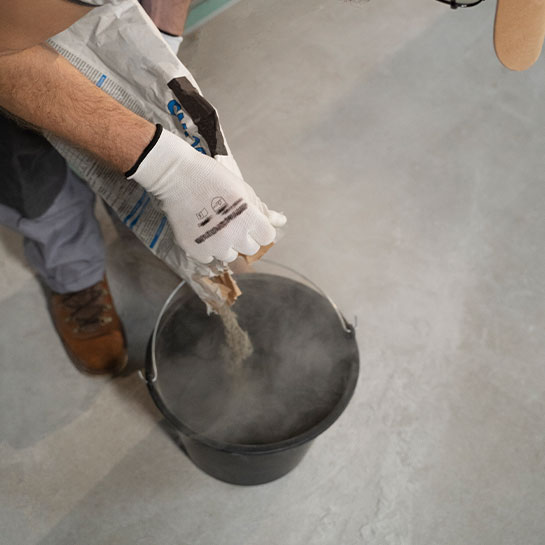
Once you have the essentials, set up the work area so that it is clean and free of objects that may hinder your maneuverability. The next step is to put the contents of the bag into the wheelbarrow. Pour the water according to the above instructions. However, it is always advisable to add only three quarters of the water indicated by the manufacturer.
For mixing, use the mixer until all the dry components are perfectly hydrated. Gradually add the remaining water. Keep in mind that the result should be homogeneous and with a sticky texture, i.e. it should not be totally liquid.
What are its main uses?
Mortar for building and construction is the main field of application, but we recommend you read on for more details.
Masons use it mainly for two types of work:
- Bonding of bricks and blocks for the construction of walls, partitions and walls. This ensures a strong and durable bond.
- It is also used for repairing and filling joints in brick and stone structures, with the purpose of strengthening their stability.
Although less well known, it is also excellent in the restoration of historic buildings. The structures are often very old and the mortar is very effective in preserving structural integrity and aesthetics.
Tiles are trending as a cladding option and dry mortar acts as a great ally. It is used to fix tiles in partitions and walls of all types. The reason is that it provides a level and fully adherent base for the installation of these types of coverings.
At ParaTuReforma we know that any type of commercial or industrial construction resorts to this material for the construction of load-bearing walls and finishes in any structure. In the commercial field (factories, offices, warehouses, etc.) it is very widespread compared to residential.
Differences between dry mortar, traditional mortar and concrete
Before deciding on the material you require for your work or renovation, it is advisable to know the difference between mortar and cement in some of its modalities.
First, the composition of dry mortar is based on a prefabricated mixture of cement, water and other additives. Traditional mortar, on the other hand, consists of cement, sand, water and lime. As far as cement itself is concerned, it is a hydraulic mixture made with limestone and clay that, once ground, becomes a fine powder.
The uses of the two materials also differ. Dry-set mortar is typically used for laying bricks and blocks. Traditional mortar is used in all types of general construction work, while cement is more focused on the manufacture of large blocks and more concrete products.
The consistency and quality are also different. With dry-mix mortar, both of these factors are typically specified by the manufacturer, so there is no major issue. In a traditional-style motorcycle, however, it usually varies depending on the mixture used.
As far as cement is concerned, it retains its binding properties. However, this is an attribute that is conditioned by the mix and its suitability with other materials.
When choosing one or the other, keep in mind their differences and take into account the needs and specifications of each work or reform. In ParaTuReforma we put at your disposal bags of dry mortar with the ideal properties so that your works and reforms are of the highest quality. Contact us without obligation by the means indicated on the web and receive personalized advice.
What is dry mortar, and what is it used for?
Dry mortar is a pre-mixed blend of cement, fine aggregates, and additives that requires only water for application. It is primarily used for bonding bricks and blocks, installing cladding, and performing on-site repairs.
What are the advantages of dry mortar over traditional mortar?
Dry mortar offers greater consistency, saves time, reduces waste, and is easy to transport. In addition, its controlled mixing ensures consistent results, which is not always the case with traditional mortar.
How does dry mortar differ from cement?
Cement is a base binder, while dry mortar is a ready-to-use finished product. Mortar contains sand and additives that improve adhesion, workability, and strength, making it easier to apply.
How do you properly prepare dry mortar?
Simply mix the contents of the bag with the amount of water specified by the manufacturer. We recommend adding three-quarters of the water first, mixing until a smooth consistency is achieved, and then adding the rest if necessary.
Is dry mortar recommended for professional renovations and construction projects?
Yes. Dry mortar is ideal for both home renovations and professional construction projects thanks to its ease of use, consistent quality, and wide range of applications in residential, commercial, and industrial construction.