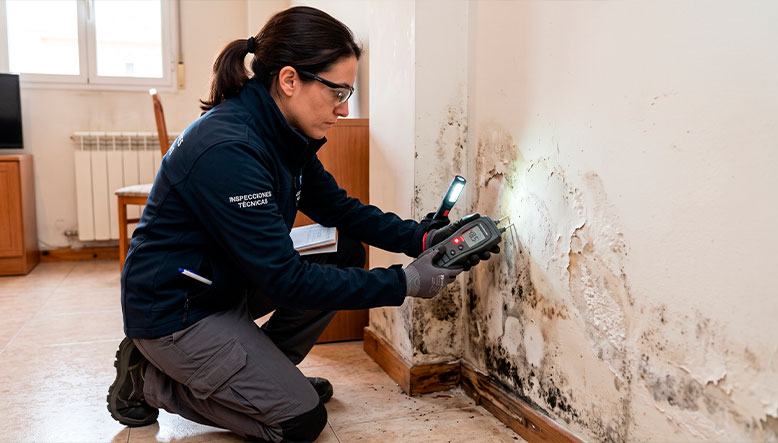
Damp walls are one of the most complex, recurring, and destructive problems that can affect a home.
Beyond the obvious aesthetic impact—dark stains, peeling paint, or flaking plaster—the constant presence of water on building facades compromises the healthiness of the spaces and can even weaken the building’s structural elements.
At Paratureforma.com, we know that the desperation to solve this problem often leads to superficial solutions or temporary fixes.
However, in the field of building pathology, there is a golden rule: it is impossible to permanently repair moisture damage unless its exact source is diagnosed with pinpoint accuracy.
To eliminate the problem, we must become true home detectives, analyzing the symptoms, visual clues, and how the water behaves on the wall.
Next, we conduct a thorough analysis to identify the different types of moisture, interpret the signs on the wall, and apply the most effective home tests before undertaking any restoration work.

Types of Moisture: Key Clues at the Crime Scene
To begin our diagnostic investigation, the first step is to categorize moisture based on its behavior and location. In the field of construction, moisture issues are divided into three distinct categories:
- Moisture from External Infiltration: This occurs when rainwater or runoff penetrates from the outside to the inside through pores, cracks, or fissures in the facade, deteriorated roofs, or poor sealing around window frames.
- Capillary Moisture: This is water from the ground that rises vertically through the pores of the foundation, footings, and load-bearing walls. It affects only the lower sections of walls on ground floors, in garages, or in basements.
- Condensation Moisture: Originates inside the home itself. It occurs when water vapor suspended in the ambient air comes into contact with a cold surface (thermal bridge), reaches the dew point, and turns into liquid water.
The Aluminum Foil Test: Decoding the Source (Inside or Outside?)
In our work as home detectives, we don’t always have access to digital hygrometers or professional thermal imaging cameras.
However, there is a foolproof and extremely accurate diagnostic trick for determining whether the water is coming from inside the room or from the core of the wall: the aluminum foil trick.
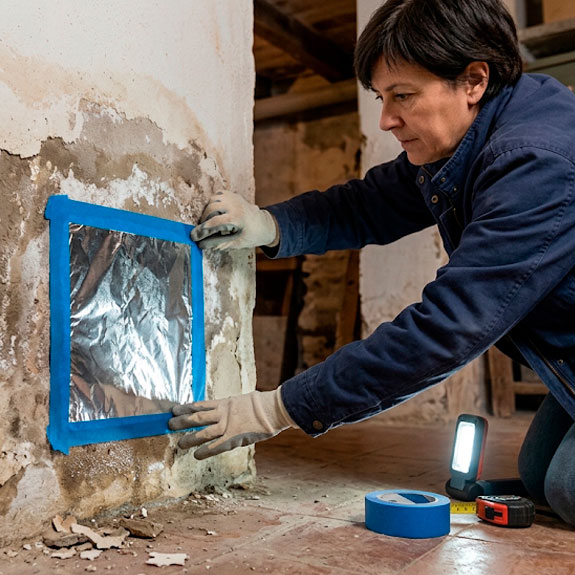
Aluminum Foil Test Procedure
- Location: Select an area of the wall that shows signs of active moisture or feels damp to the touch.
- Preparation: Cut a square of aluminum foil measuring approximately 20 cm x 20 cm.
- Airtight Seal: Apply the aluminum foil directly to the affected area. It is crucial to completely seal all four edges using masking tape or high-adhesion duct tape, ensuring there are no gaps through which air can circulate.
- Curing time: Leave the film in place for 24 to 48 hours without touching it.
Interpretation of Diagnostic Results
Once the waiting period has elapsed, carefully observe where water droplets or a film of condensation have formed:
- Water accumulates on the OUTSIDE surface of the aluminum foil (the side facing the room): This is conclusive evidence. The moisture comes from the indoor environment of the home. This is clearly a problem of condensation, caused by poor ventilation, excess water vapor, or inadequate thermal insulation in the wall.
- Water accumulates on the INSIDE surface of the aluminum foil (the side against the wall): The wall is pushing water inward. The source is either an external leak or rising damp. The water is passing through the wall structure.
Symptom-by-Symptom Analysis: Visual Inspection and Location
A good building inspector must learn to interpret the marks that water leaves in its wake. Each type of moisture reveals its presence in a completely different way.
1. Damp Spots at the Base of the Wall (Up to 1 Meter High)
If the stains start at floor level and spread upward in an irregular pattern, creating a sort of horizontal “tide” that rarely exceeds one meter or one and a half meters in height, we are dealing with capillary moisture.
- Additional clue (salt efflorescence): It is very common to see a white, spongy, or crystalline powder appear on the paint. This is caused by mineral salts from the soil that are carried up by water and crystallize as the liquid evaporates from the surface. If the paint bulges and peels off in flakes along with this salt, capillary action is to blame.
2. Circular, Isolated Stains Anywhere on the Wall
If moisture appears in the middle of the wall—far from the floor and ceiling—forming a clearly defined ring that darkens dramatically after a period of heavy rain, the cause is a lateral leak.
- Inspection of the exterior wall: Check the exterior facade at that same height. You are very likely to find cracked plaster, porous bricks, deteriorated expansion joints, or window sills without drip edges.
- Plumbing Inspection: If the stain is located near a bathroom or kitchen, you should rule out a micro-leak in the domestic water pipes or drain lines.
3. Black Mold, Stains in Corners, and Cold Spots
When you notice black, greenish, or moldy spots in the upper corners of the walls (where they meet the ceiling), behind large cabinets against exterior walls, or around window frames, the diagnosis points directly to condensation caused by a thermal bridge.
Mold spores thrive where the relative humidity consistently exceeds 65%. This level of humidity does not usually damage the underlying mortar plaster, but it does degrade the surface layer of paint and causes a characteristic musty odor throughout the room.
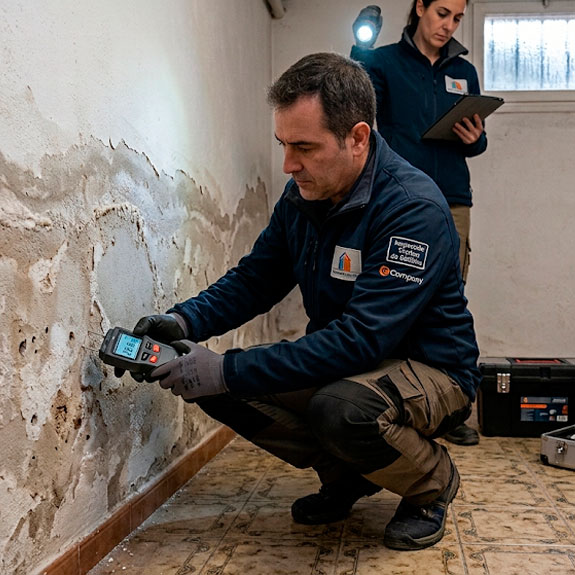
Technical Solutions Based on the Diagnosis
Once the inspection report has been finalized and the true source of the moisture has been identified, it’s time to take action using the right building materials, which you can find at Paratureforma.com
Outdoor Filtration Solutions
- Application of high-adhesion waterproof mortar to the exterior wall.
- Treatment of facades using transparent, deep-penetrating water-repellent agents (silanes and siloxanes) that seal the porosity of the brick without altering its appearance or impeding its breathability.
- Sealing cracks and joints with professional-grade elastic polyurethane sealants.
Solutions for Capillarity
- Creation of chemical barriers by injecting water-repellent resins or silane gels into the base of the wall.
- Replacement of traditional mortars with macroporous dehumidifying mortars, which allow water to evaporate quickly without damaging the finish.
Condensation Solutions
- Installation of interior thermal insulation (SATIN/SATE) or drywall cladding incorporating high-density mineral wool to eliminate cold spots.
- Application of anti-condensation or thermal paints containing ceramic microspheres, which help even out the wall’s temperature and prevent mold spores from taking hold.
Final Conclusion
Finding out where moisture in a wall is coming from requires a systematic approach, careful observation, and the use of simple but foolproof diagnostic tests, such as the aluminum foil test. Correctly identifying whether the problem is caused by leaks, capillary action, or condensation is the only way to avoid wasting money on temporary cosmetic fixes that will fail again after just a few months.
Once the diagnosis has been accurately determined, at Paratureforma.com we have the entire range of technical products needed—waterproofing mortars, chemical barriers, injection resins, and thermal paints—to restore your walls and permanently bring health and comfort back to your home.
What are the three main types of moisture that can affect a wall?
Moisture is divided into three main categories based on its source: moisture from external seepage (entering from the outside), moisture from capillary action (rising from the ground), and moisture from condensation (generated within the indoor environment).
What is the aluminum foil trick for detecting moisture?
This involves taping a square of aluminum foil (20×20 cm) over the stain and sealing the edges with tape. After 24–48 hours, if water accumulates on the outer side, it is condensation; if it is on the inner side (against the wall), it is seepage or capillary action.
How can I visually tell if my wall has rising damp?
This type of moisture affects only the lower parts of walls (ground floors or basements). It appears as a rising stain that rarely exceeds one and a half meters in height and is usually accompanied by a white powdery substance known as salt efflorescence.
What does the appearance of black mold in the corners or behind furniture indicate?
Dark mold in the upper corners or in cold areas of the wall indicates a clear problem with moisture from condensation. This occurs when there is excess water vapor in the air, poor ventilation, or inadequate thermal insulation (thermal bridge).
To eliminate it, thermal insulation must be improved by installing a lining with mineral wool (or an ETICS system). In addition, as a palliative measure, it is very effective to apply anti-condensation paint containing ceramic microspheres to even out the wall’s temperature.