Discounts of up to 30% during the long weekend

Advantages of polyurethane

Lightweight - Polyurethane is much lighter than other materials, allowing you to include or add products without re-engineering into your project infrastructure.

Easy to work with - All of our products can be installed using standard woodworking tools. Installation is quick and easy, and can be done in much less time than other similar products made from traditional materials.

Low Maintenance - Polyurethane products are impervious to moisture, never rot or deteriorate in high humidity. The products are resistant to environmental degradation and do not break, deform or break apart, as wood does. The products are resistant to termites and other destructive insects. The products can be used for internal and external use (without being exposed to the sun), it can be painted to match any décor.

Vigas poliuretano

Installation of hollow polyurethane beams

Instalación Vigas de poliuretano huecas

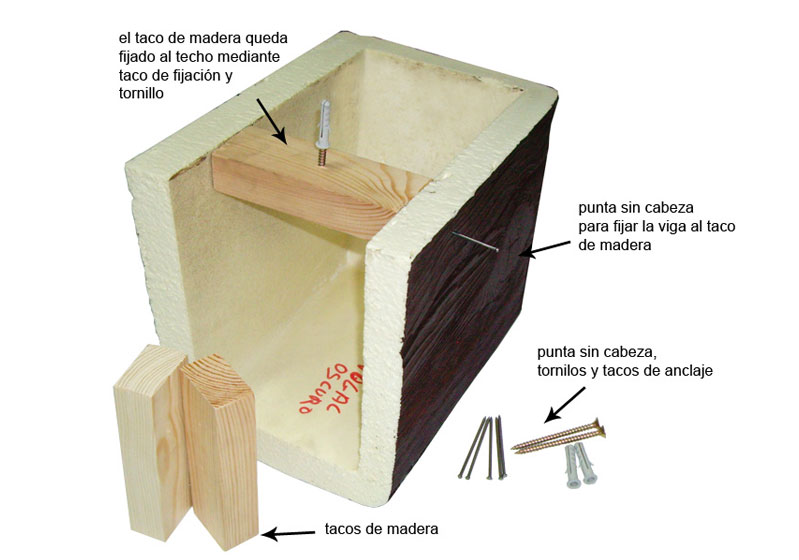
Installation Kit Detail View

For the installation of hollow polyurethane beams, follow the steps below:

  1. Plan the location they will have, much more so if you have to cover a length longer than the length of the beams. A sketch by hand, with the measurements will be enough.
  2. The beams have an assembly kit, which consists of wooden plugs, screws and fixing plugs, which will serve to fix the beam to the ceiling (as long as they are on a smooth ceiling). You should distribute these wooden dowels along the length of the beam.
  3. Wooden dowels that are attached to the ceiling should be aligned. These are the ones that will then fix the beam, so its alignment is essential. Use a line puller or a rope to fix these plugs.
  4. If you have to cut the beam, use a box cutter, the cut will be much cleaner and straighter.
  5. To finally install the beam, you will need to attach it to the wooden blocks that we have just put on the ceiling. As they have very little weight, they can be fixed with fine nails without a head (pins), or, if it is one of the beams with a larger section, they can be screwed and then covered with the touch-up kits, which will cover the screw with the same color as the beam and will be invisible.
  6. If you have joints between beams, cover them with faux wrought iron joints. They are easy to cut (with scissors) and are attached to the beams with cyanoacrylate-type quick glue.

Installation of solid beams

To install this type of beam, follow the steps below:

The procedure for the installation of this type of beam is different from that of hollow beams on a smooth roof.

If the ceiling is painted with stipple or is not in perfect condition, the support is not adequate, and it is essential to scratch it with a putty knife, removing all the elements on the surface that may damage the adhesive. This type of scratching allows the adhesive to fix the beam to the ceiling at more points.

The beam will be glued using special polyurethane adhesive, such as silicone. With a 300ml cartridge you will have approximately two beams. First, pour the adhesive onto the beam and then fix and detach from the ceiling for a few minutes, then fix again with enough pressure so that there are no bubbles between the beam and the ceiling. (You need to be careful not to press too hard so you don't split the polyurethane.)

In the video tutorials section you can see how to use the mounting adhesive.

Installation of polyurethane panels

For the installation of this type of panel on the roof of our home, we recommend preparing a series of wooden slats on the ceiling, on which the panels will later go.

The direction of these slats shall be perpendicular to that of the slats, and they shall be separated from each other by no more than 60 cm.

The panels will be fixed to these slats by screws.

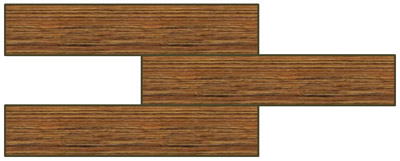
You should try to make sure that the panels are staggered with each other, to prevent all the joints from being in the same place.

Vista de un panel de Poliuretano

Gluing the corbels

To attach the brackets to the beams, the wall or any other support, it is ideal to glue them with special mounting adhesive for polyurethane.

The way it is fixed is similar to that used with beams;

  1. A zig-zag cord is placed on the smooth faces that will be glued together
  2. It is glued to the place where the bracket will go
  3. It is removed again, and after a few minutes, it is permanently glued again, applying enough pressure for the adhesive to do its job.

Gluing of the imitation forging joints

To glue the joints you must follow these steps:

  1. Measure the total length that the joint should be around the beam.
  2. Cut the roll of the joint with scissors with the measurement taken.
  3. Glue the joint with a cyanoacrylate-type quick glue, such as SuperGlue.

Colors of polyurethane beams and panels

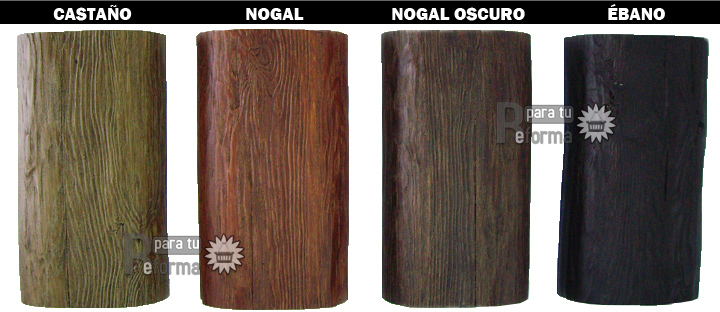
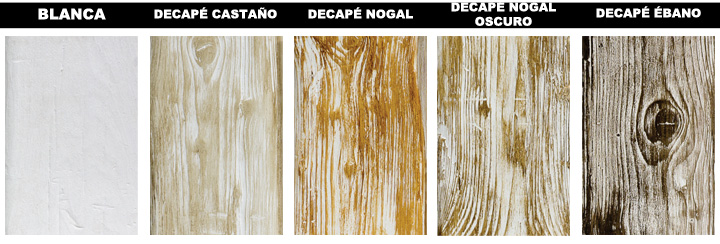
To have a broader view and with all the possibilities of color combination you can see the following photo gallery.

Gama de colores de viga imitación a madera

Colour ranges of imitation wood beams

Gama de colores de viga imitación a madera clara

Range of colors pickled with white: (artisanal process)

NCS colours of the beams made of polyurethane

Rustic chestnut: (very light browns)

S3020-Y10R

S 3020-Y20R

Walnut: (light brown)

S 6020-Y40R

S 6020-Y50R

S 5030-Y50R

S 5030-Y60R

Dark Walnut: (dark browns)

S 7005-Y80R

S 7005-Y50R

S 8005-Y50R

Ebony: (almost black)

S 7502-R

S 7500-N

S 7502-Y