Enjoy discounts of up to 30% only during the long weekend.

What should I consider before buying ceramic tiles?

BASIC CONDITIONS IN THE CHOICE OF A CERAMIC TILE

Before purchasing any product, our recommendation is to carry out an analysis or study of it that serves as a knowledge base and that, as a last cause, avoids errors in the choice and subsequent problems with the material already installed. Ceramics are a very diverse material and the possibilities that exist on the market are very wide. Here are the first notions you need to keep in mind before buying a ceramic tile.

Where am I going to place it?

This is the first question to ask and the point from which to start. Based on this, all the characteristics that the tiles must have for their correct choice will be determined.

You should take into account whether your use is for outdoor or indoor, and whether it is for floors (flooring) or walls (cladding).

Is it going to be very busy or is it going to suffer normal wear and tear?

We must take into account whether the ceramics, due to their location, are going to be subject to constant pedestrian crossing, heavy traffic, wear and tear due to raw footsteps, or exposed to possible stains. All these aspects must be studied to determine what minimum requirements must be considered in terms of scratching, abrasion, slipping, etc.

What properties or characteristics should ceramic tiles have?

In general, there will be 4 fundamental properties that you should know in a ceramic tile:

1. WATER ABSORPTION

The first and main one is water absorption. It is, together with the colour of the raw material, the quality that gives ceramic tiles their name. In addition, properties such as frost resistance directly depend on it as well. They are known by the following names:

PORCELAIN STONEWARE: Ab < 0.5 - Interior and exterior walls and floors

THICKNESS: 0.5 ≥ Ab > 3 - Interior and exterior walls and floors

GLAZED GRES: 3 ≥ Ab > 6 - Interior floors and walls

TERRACOTTA: 6 ≥ Ab > 15 - Interior and exterior walls and floors (Does not resist frost)

TILES: Ab ≥ 10 - Interior Walls

2. ANTI-ICE

It is essential to know whether or not the tile to be laid will be frost resistant. This property is necessary for outdoor installation.

To determine this characteristic, the ISO 10545-12 anti-icing standard is followed and consists of subjecting a sample 100 times to temperature changes between -5ºC to +5ºC, previously immersed in water. If they do not show damage, it is assumed as 'anti-freeze'.

3. SLIP RESISTANCE

This is an exclusive feature for flooring and responds to the ability of ceramic tiles to resist slipping or slipping.

There are 3 classes of Slip Resistance (Rd) that determine the standards:

  • Rd ≤ 15 Class 0
  • 15 < Rd ≤ 35 Class 1
  • 35 < Rd ≤ 45 Class 2
  • Rd > 45 Class 3

See the minimum classes required for soils according to their location.

Dry inland areas:

  • Surfaces with a slope of less than 6% - Class 1
  • Surfaces with a slope equal to or greater than 6% and stairs – Class 2

Wet indoor areas, such as entrances to buildings, covered terraces, changing rooms, showers, kitchens,...

  • Surfaces with a slope of less than 6% - Class 2
  • Surfaces with a slope equal to or greater than 6% and stairs – Class 3

Indoor areas where agents (greases, lubricants) may be present in addition to water, such as industrial kitchens, slaughterhouses, industrial use,... – Class 3

Outdoor areas. Swimming pools and showers (areas provided for barefoot users and at the bottom of pools when the depth is no more than 1.5m) – Class 3

4. WEAR RESISTANCE, ABRASION AND SURFACE HARDNESS

Wear and abrasion resistance: It is the method of measuring the concealment capacity of wear suffered by abrasion, such as that produced by footwear.

5 levels are established:

  • Nivel 1 – Low
  • Nivel 2 – Medium
  • Nivel 3 – Medium High
  • Nivel 4 – High
  • Nivel 5 – Very High

Hardness or scratch resistance: To determine the hardness or scratch resistance, a test is carried out by scratching the surface with the 10 materials on the MOHS scale in increasing form. The minimum required for cladding is Mohs 3 and for flooring is Mohs 5.

Other aspects to take into account in ceramic tiles

TYPES OF STONEWARE ACCORDING TO RAW MATERIAL

Their differences come mainly from the clays used, their color of origin and their treatment, conferring the characteristics of each material. If you have any doubts about which is the most recommended, do not hesitate to contact us.

  • Red Paste. It is the most widespread and economical stoneware, its name derives from the clays that compose it, reddish tones. A layer of coloured glazes is applied to the clay base that will give the image of the piece.
  • White Paste. Its name also comes from the clays that compose it, in this case whitish. Recommended for both interior and exterior, they may or may not present an enamel layer, such as an extruded rustic.
  • Porcelain Stoneware. It is composed of the same type of clays and sandstones as a whole, but with greater pressing, giving it the highest resistance on the market.

RECTIFIED TILE

The normal ceramic tile has rounded edges, which make it necessary to use installation joints, the rectified tile however is cut by a jet of water thrown under pressure on the virgin piece, obtaining tiles whose edges have a perfect cross-section.

The placement of these pieces makes the separation between the tiles imperceptible. Even so, we always recommend a minimum joint that absorbs the expansions and contractions that all materials suffer from temperature changes.

THICK STONEWARE

It does not reach the characteristics of porcelain stoneware but has the following advantages that allow it to be used outdoors:

  • Minimal water absorption
  • High resistance to breaking load
  • High hardness to scratching and abrasion
  • Resistance to frost and thermal shock

WHAT IS TONE AND CALIBER?

Due to the characteristics of the ceramic material, its elaboration by chemical and firing means, it is practically impossible for two productions differentiated in time of the same model to have 100% accuracy.

That is why different shades and sizes come out of the same model, for different production batches, understanding by tone the appearance or image of the product and the gauge by the thickness of the piece.

Our recommendation is to purchase complete batches with enough product for installation, and in case of buying the same model on different occasions, always ask for the tone and caliber.

TONAL VARIATION OR SHADING

We should not confuse Tonal Variation with Tone and/or caliber.

By tonal variation we mean the intentional shading by the design of the parts and the model itself.

As an example, we give several possibilities that could be found, with a greater or lesser degree of tonal variation.

Variación tonal muy leve
Variación tonal leve
Variación tonal Media
Variación tonal fuerte

CERAMIC PIECES

There are a wide variety of special pieces.

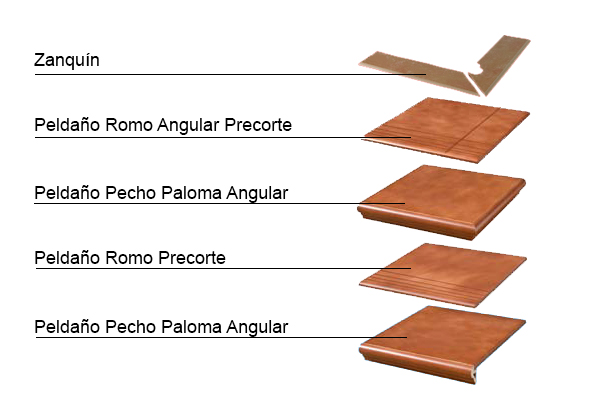
As an example, we indicate the most common ones related to steps:

Tipos de pieza de cerámica

Optimize results with the following insights

Once you have decided on the product that best suits your requests, both physical and aesthetic, you should know that you can still improve your purchase, optimizing costs in complementary items as well as in the performance of the ceramic tile itself when installed properly.

How much material do I need?

Measure the m2 of the room or room, if you have out-of-square or diagonal limits we recommend you to calculate with the maximum measurements to avoid material shortages at the last moment.

It is important to add between 10% and 15% to the m2 obtained, anticipating the breakage and waste of some pieces and cuts to accommodate the imperfect sides of the walls.

Which mortars are suitable?

Nowadays there are many brands on the market and a great diversity of mortars. Our recommendation is that you ask us if you have any doubts about the correct choice of cement and for this, we offer you, in the section of Mortars, Cements and Aggregates, a wide range of specific adhesive cements for each of the possibilities of ceramic tiles, their characteristics and the environment in which they will be placed. In each of the articles you can obtain your user and application guide, where you will find the details of all the products and installation systems.

How do I correctly position the parts?

First of all, we must evaluate the condition of the support on which we will install the ceramics; Check that it is resistant, that it is clean, that it has the right flatness, that it is sufficiently absorbent and rough, and that it is also stable. Then we prepare the mortar and apply; A) in thin layer (for supports with good flatness) with a notched trowel or B) in a thick layer (poor flatness of the support) with a trowel or palauster. Adhesive cements should not be used in thick layers, so first, you must prepare the support to be able to use them.

For a correct execution we recommend that you use ceramic leveling systems that ensure the flatness of some pieces with respect to others after the cement glue has set.

Finally, after 24-48 hours, the grouting will be carried out with a grout-type mortar or special mortar for joints that you will also find on our website.

How to install and maintain wall and floor tiles correctly

INDOOR PLACEMENT

  1. It is essential that before starting the installation the substrate has matured and is perfectly dry and hardened (that all the shrinkages due to setting have taken place), to avoid the appearance of pathologies such as lifts or fissures resulting from lack of stability.
  2. Before its placement, check quality, tone and caliber, as well as that the material is free of possible visible defects. For a better decorative effect, the pieces of several boxes should be mixed. Carefully handle the material to avoid blunting or chipping on the edges of the tiles.
  3. Under no circumstances wet or immerse the pieces in water before installation or install them using traditional mortar (thick layer). Install in a thin layer using a notched trowel and adhesive cements of at least type C1 (EN 12.004 standard). For large formats (one side larger than 40 cm.) use the double gluing method. Scrupulously comply with the requirements of the cement glue manufacturer's use: method, time and proportion of water in the mixing, open laying time, etc.
  4. The use of installation joints of at least 1.5 mm is required. Make sure that the bonding material has been fully hardened before grouting it. Fill the joint with specific grouting material to prevent possible leaks. Do not use borada, grout, or any type of cement-based grout material.
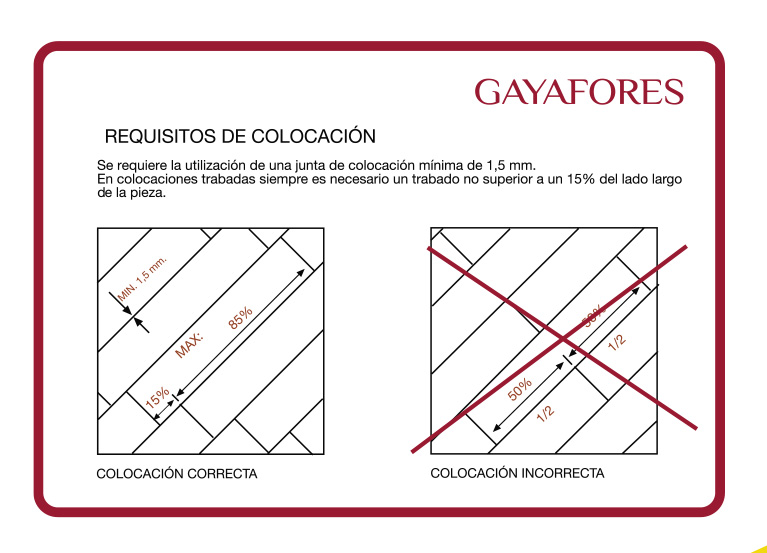
  5. If you want to make a locked placement, never do it more than 15% of the longest side of the piece (for example, for locks of the 12.8 x 65 size, do not lock more than 15%, about 10 cm.)
  6. If additional construction work has to be carried out, the pavement must be protected to prevent scratching with any abrasive object.
  7. After installing and grouting the tiles, remove any remaining bonding or grouting material with a specific material for cleaning construction debris (descaler or cement remover), scrupulously complying with the requirements for use and the concentrations indicated by the manufacturer of the same. In any case, we recommend that before using any chemical product, you test the effects of any chemical product in an invisible place on the tile.
  8. For daily tile cleaning, use only hot water and a household detergent or diluted ammonia. Do not use harsh products or products containing acids, especially salfuman or hydrofluoric acid.

PLACEMENT AND MAINTENANCE OF SPECIAL PARTS

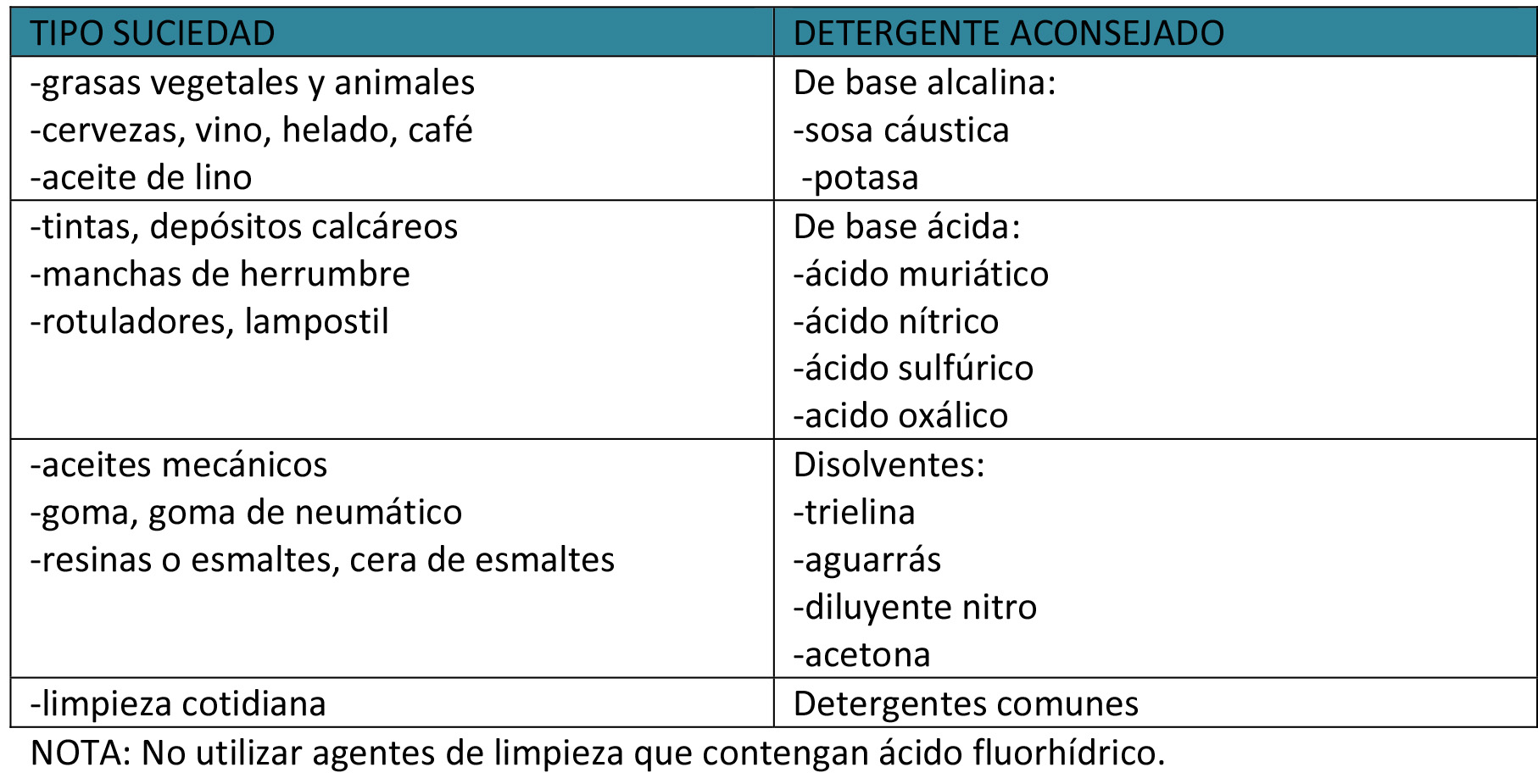
In our catalogue we have special pieces that are not made of ceramic material, they can be made of marble, glass, metal, resin, etc. Pay special attention to the placement and cleaning instructions that we enclose in the boxes of each of these references. Especially in this type of pieces, do not use aggressive materials for cleaning (abrasive scouring pads, salfumán or acid-based cleaning agents).

Tabla de colocación y mantenimiento de piezas especiales

OUTDOOR INSTALLATION

Outdoor installation is especially critical, so in addition to the general installation requirements, it is essential to follow specific requirements for outdoor installation. In the event that the installation is carried out in an AREA WITH RISK OF FROST, only install PORCELAIN tiles, do not place stoneware or red paste or white body cladding under any circumstances. In any case, you must meet the following placement requirements.

  1. In laying on pavements, a minimum slope of 2% is necessary to facilitate water evacuation. It is also necessary to place a drainage layer and drain under the tiles.
  2. Use adhesive cement type C2 (according to EN 12.004). Perform the placement of the pieces using the double gluing method, solidizing correctly to avoid the generation of gaps under the pieces.
  3. Install a minimum 5 mm placement joint. Use a specific outdoor grouting material (type CG2 according to EN 12.004).
  4. Respect the structural and perimeter joints. Place expansion joints every 10-20 m2.
  5. Pay special attention to the joints between the tile and other elements such as columns, walls, railings, etc., placing the necessary joints to prevent water filtration.

LAYING OF GRINDING

Although the installation requirements are the same as for any type of tile, rectified materials are particularly delicate, especially in the corners and edges of the same, therefore the installation of this type of tile is especially critical and in addition to the general installation requirements, special attention must be paid to the following:

  1. The planarity of the installation support is extremely important. The surface on which the installation is to be carried out must be previously mastered (level).
  2. Carefully handle the material to avoid blunting or chipping on the edges of the tiles
  3. Do not immerse the tiles in water, as after getting wet they could suffer modifications in the planarity. Install in a thin layer using cement with the (type C1 for interiors and type C2 for exteriors – according to EN 12.004).
  4. Always place a minimum installation joint of 1.5 mm.
  5. If you want to perform a locked placement, never do so at more than 15% of the length of the piece.
Colocación de baldosas rectificadas